|
|
|
|
|
|
|
|
|
|
|
|
|
|
|
|
|
|
|
|
|
|
|
|
|
|
|
|
|
|
|
|
 |
|
|
|
|
|
|
 |
|
|
|
|
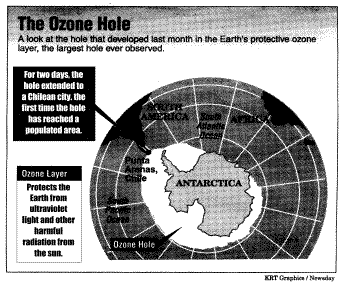
.....Wellington, New Zealand - The hole in the ozone layer over
Antarctica stretched over a Chilean city when it ballooned to
a record size last month, the first time it has reached a populated
area, scientists said yesterday.
.....Previously, the hole had opened only over Antarctica and
the surrounding ocean.
.....Citing data from the U.S. space agency NASA, atmospheric
research scientist Stephen Wood said the hole covered 11.4 million
square miles-an area more than three times the size of the United
States-on Sept. 9 and 10.
.....For those two days, the hole extended over Punta Arenas,
a southern Chilean city of about120,000 people, exposing residents
to very high levels of ultraviolet radiation. Too much UV radiation
can cause skin cancer and destroy tiny plants at the beginning
of the food chain.
.....Dr. Dean Peterson, science strategy manager of the
Antarctica New Zealand research group, said Wood's findings
showed a city being exposed to the ozone hole for the first time
..."The longer it gets, the greater the chances of populated area |
|
|
|
being hit by low ozone levels," said Peterson, who was not involved
in the study. Peterson said smaller spots of low ozone could affect
Argentina and even the tip of South Africa, Australia or New Zealand.
...."The hole won't grow to that size," he said. "But as it breaks
apart, fingers of low ozone, or filaments as we call them, will
go over major land mass areas. Those filaments will be over the
land mass for a few weeks." Last month, scientists expressed surprise
when NASA data from Sept. 3 showed the hole at just under 11 millionsquare
miles, the biggest it had ever been. It continued to grow in the
days afterward, according to the data cited byWood. Record-low
temperatures in the stratosphere are believed to have helped the
expansion of the ozone hole during the Southern Hemisphere's spring
season. Antarctic ozone depletion starts in July, when sunlight
triggers chemical reactions in cold air trapped over the South
Pole during the Antarctic winter. It intensifies during August
and September before tailing off as temperatures rise in late
November or early December. Depletion of the ozone layer over
Antarctica and the Arctic is being monitored because ozone protects
Earth from harmful ultraviolet radiation.
.....Human-made chlorine compounds used in refrigerants, aerosol
sprays, solvents and foam-blowing agents, and bromine compounds
used in firefighting halogens, cause most ozone depletion. The
temperature over Antarctica also significantly affects the size
of each year's hole. Starting in October, warmer temperatures
reduce the ability of chlorine and other gases to destroy ozone.
.....Experts agree that the amount of man-made chemicals is leveling
off thanks to the 1989 Montreal Protocol, which commits countries
to eliminating production and use of ozone-depleting substances.
But it could be 20 years before ozone levels recover noticeably.
"Although CFC levels will begin to reduce over the next 10 years,
variations in the weather pattern will continue, "Peterson said.
© Newsday, Inc.
|
|
|
|